
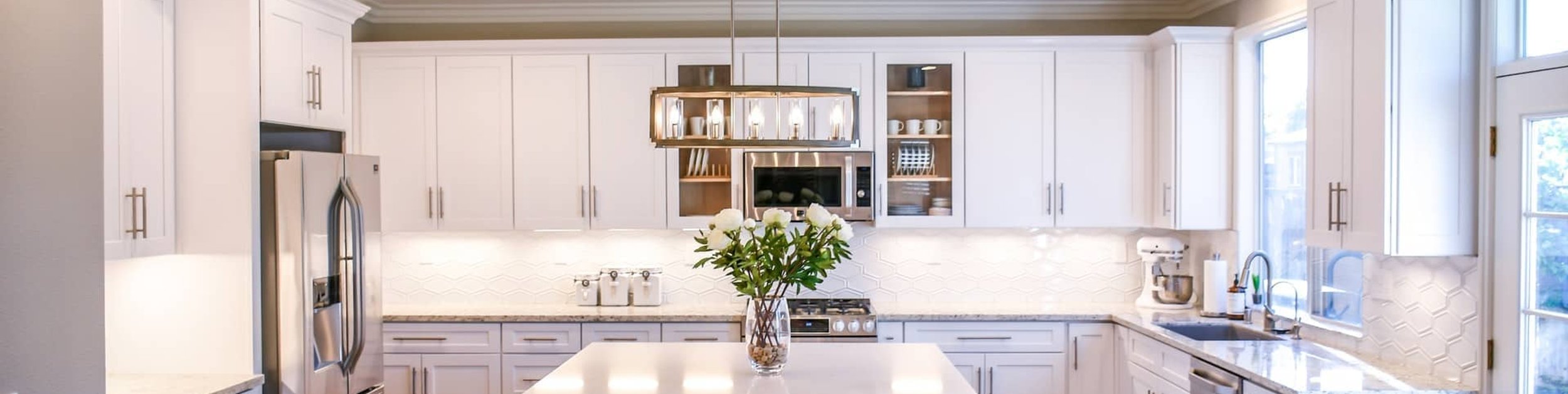


"How much is a new kitchen going to cost me?" It's the first question almost every client asks me, and it's a fair one. It's also the hardest to answer with a single number, because a kitchen renovation isn't one product. It's cabinetry, worktops, appliances, labour and often first-fix plumbing and electrics, all priced separately and added together. This guide breaks down what UK homeowners actually spend at each tier and what drives the difference. It also covers how to budget realistically for a project across Edinburgh, the Lothians, Fife and the Borders.
What You Need to Know
- A UK kitchen renovation typically runs from around £7,000 for a budget refit to £47,500 average for a full bespoke design (Checkatrade, 2026; Checkatrade, 2026).
- Worktop material alone can swing your budget by thousands: laminate averages £30-£80/m², quartz averages £375/m², granite averages £435/m² (Checkatrade, 2025; MyBuilder, 2026).
- 38% of UK homeowners exceeded their renovation budget in 2026, while 26% never set one at all (Houzz, via kbbreview, 2026).
- We deliberately quote in tiers rather than fixed prices, since the same "kitchen renovation" can mean £8,000 or £60,000 depending on scope.
What Does a New Kitchen Cost in Edinburgh in 2026?
There's no single "average kitchen price," because scope varies so much between projects. The most useful way to budget is by tier, based on current UK-wide cost data. A small budget refit starts from around £7,000. A typical mid-range renovation averages £10,550-£17,500. A large or premium fitted kitchen can reach £28,400 or more (Checkatrade, 2026; Houzz 2025 UK Kitchen Trends Study, 2025).
We don't have Edinburgh-specific published cost data to point to honestly, but I can tell you what actually pushes cost up on the ground here. Tenement flats and older properties are the main factor: tight stair access, narrow closes, and top-floor flats with no lift all add time and cost that a standard new-build never has to deal with. On the top end, our own premium and bespoke jobs across Edinburgh, the Lothians, Fife and the Borders typically land at or under about £50,000 all-in, even for a full custom fit, below the £75,000 national bespoke figure above, which blends in higher-cost UK regions this data doesn't separate out. None of this shows up in a UK-wide average, and it's exactly why we quote per project rather than off a price list.
| Tier | Typical UK Cost | What Tends to Drive It |
|---|---|---|
| Budget | £5,000-£10,000 | Standard units, laminate worktop, like-for-like layout |
| Mid-range | £10,000-£20,000 (2025 average £17,500) | Better cabinetry, quartz or solid-surface worktop, some layout changes |
| Premium / high-end | £20,000-£55,000 | Custom cabinetry, integrated appliances, luxury fittings, structural changes |
| Bespoke | £20,000-£75,000 (average £47,500) | Fully bespoke joinery and design, bespoke appliance package |
Sources: Checkatrade New Kitchen Cost, 2026; MyBuilder Kitchen Renovation Cost Guide, 2026; Checkatrade High End Kitchen Cost, 2024; Checkatrade Bespoke Kitchen Cost, 2024.
Where Does Your Kitchen Budget Actually Go?
Labour and materials split differently depending on the tier you're working in. On a budget job, installation labour is often the single biggest line item. On a premium job, units and appliances take over. Fitter day rates typically run £250-£350, with labour-only fitting averaging around £3,500 for a standard kitchen (Checkatrade, 2026).
| Cost Element | Budget Tier | Average Tier | Premium Tier |
|---|---|---|---|
| Installation labour | £2,200 | £3,000 | £4,600 |
| Units and cabinetry | £1,500 | £3,000 | £10,000 |
| Appliances | £450 | £2,000 | £5,200 |
| Worktop | £100 | £1,000 | £5,000 |
Source: Checkatrade New Kitchen Cost, 2026.
Rather than moving one number, moving up a tier moves several at once. That's why a "just upgrade the worktop" request often has knock-on costs elsewhere, in support brackets, upstands, or fitting time, that a fixed price list won't show you.
Which Worktop Material Actually Fits Your Budget?
Worktop choice is one of the biggest single swings in a kitchen budget, and it's where I get asked the most "is it worth it?" questions. Laminate worktop averages £30-£80 per square metre supplied and fitted. Quartz averages £375/m² (range £200-£550), and granite averages £435/m² (range £270-£600) (Checkatrade, 2025; MyBuilder, 2026).
Quartz has become the dominant choice nationally. It made up 42% of worktop material choices in the 2025 Houzz UK Kitchen Trends Study (Houzz, 2025). Wood or butcher block followed at 14%, laminate also at 14%, solid surface at 12%, granite at 10%, and marble at 5%. It's non-porous, doesn't need sealing like granite or marble, and holds up well to daily use, which is probably why it's overtaken granite as the default premium choice.
Is laminate a compromise? Not necessarily. A well-fitted laminate worktop, correctly templated and sealed at the joins, performs perfectly well for most households. Where I'd steer a client toward stone is heavy daily cooking or resale value on a higher-spec property. Or a look that laminate genuinely can't replicate, like a book-matched quartz island.
Does a New Kitchen Actually Pay for Itself?
It can, within limits. A non-structural kitchen renovation, new units, worktop, appliances, same footprint, typically adds 5-10% to a home's value. A structural renovation that adds usable space can add 10-15% (Which?, 2026). We've looked at this from a slightly different angle before too, in our full kitchen installation process guide, which cites a comparable 5-15% uplift estimate on mid-tier properties.
Which?'s general guidance is to cap kitchen spend at 10-15% of your home's current value, so the renovation doesn't outprice the property around it. That's a useful sense check before you fall in love with a bespoke spec that a £220,000 flat can't really support in resale terms. It's also worth remembering that kitchen costs have risen faster than general inflation. Which? recorded a cumulative 22% increase in kitchen costs between 2019 and 2023, based on RICS/BCIS data, an average of 5.1% a year (Which?, 2024). Budgeting off a quote from a couple of years ago will underestimate today's price.
How Do I Avoid Blowing My Kitchen Budget?
Most people do, at least a little. In the 2026 Houzz UK renovation survey, 38% of homeowners exceeded their renovation budget (Houzz, via kbbreview, 2026). Only 33% stayed on budget, 3% came in under, and 26% didn't set a budget at all. Not setting one at all is the riskiest position of the four.
A realistic contingency is 10% of the total project cost, rising to 15% or more on older properties or anywhere structural work is involved (FMB, 2026). Most homeowners fund renovations from savings, 83% do, according to Houzz's 2025 renovation trends study (Houzz, 2025). Staged builder payments are the norm too, commonly a 10% deposit followed by milestone payments, rather than paying everything upfront.
Underestimating a budget isn't the only way this goes wrong, either. Choosing the wrong installer costs people real money nationally. Unqualified "cowboy builders" are estimated to have cost UK consumers £14.3 billion, with an average individual loss of £1,759 (FMB, 2025). We've covered the specific mistakes behind that kind of loss in more detail in our guide to the 10 most common kitchen installation mistakes. Most of them cost far more to fix afterward than they would have to avoid from the start.
Why We Quote in Tiers, Not a Fixed Price List
You'll notice we haven't given you one number for "a Precision Kitchens kitchen." That's deliberate, not evasive. Two kitchens can look almost identical on a mood board and cost £10,000 apart. The difference is what's behind the walls: whether pipework needs moving, whether the electrics need a new circuit, whether the floor's actually level under the old units.
As a rule, our quotes include full fitting, tiling and flooring installation. You'd source the tiles and flooring material yourself, the same as most fitters in the area work.
A fixed price list either has to assume the easiest possible job, which under-quotes almost everyone. Or it pads every price to cover the worst case, which over-quotes almost everyone. Neither helps you plan a real budget. What actually works is a site visit and an itemised quote, broken down the way the tables above are broken down. Then an honest conversation about which tier fits your space and your budget. If you'd like to talk through what your project would actually cost, get in touch and we'll arrange a visit. You can also see examples of finished projects across the tiers in our portfolio.
Frequently Asked Questions
How much does an average kitchen renovation cost in the UK?
Most UK kitchen renovations fall between £10,000 and £20,000, with a 2025 average of £17,500 (Houzz, 2025). Budget refits start from around £7,000, and bespoke, fully custom kitchens average £47,500 (Checkatrade, 2026).
Is quartz worth the extra cost over laminate?
It depends on your priorities. Quartz averages £375/m² against laminate's £30-£80/m². It's non-porous, needs no sealing, and is now the most popular UK worktop choice at 42% market share (Houzz, 2025; Checkatrade, 2025). For heavy daily use or resale value, it's usually worth it.
Does a new kitchen add value to my home?
Yes, within reason. A non-structural renovation typically adds 5-10% to your home's value, and a structural one that adds space can add 10-15% (Which?, 2026). Which? recommends capping kitchen spend at 10-15% of your home's current value.
Why don't you publish fixed kitchen prices?
Because the same brief can cost £8,000 or £60,000 depending on what's behind the walls, the worktop material, and appliance tier. A fixed list either under-quotes complex jobs or over-quotes simple ones. We quote from a site visit and an itemised breakdown instead, so the number reflects your actual project.
How much contingency should I budget for a kitchen renovation?
Budget at least 10% of the total project cost as contingency, rising to 15% or more for older properties or any structural work (FMB, 2026). In 2026, 38% of UK homeowners exceeded their renovation budget entirely, so a contingency isn't optional padding, it's realistic planning (Houzz, via kbbreview, 2026).
Sources
- Checkatrade — New Kitchen Cost 2026 (retrieved 26 September 2026)
- Checkatrade — Kitchen Fitting Cost 2026 (retrieved 26 September 2026)
- Checkatrade — High End Kitchen Cost (retrieved 26 September 2026)
- Checkatrade — Bespoke Kitchen Cost (retrieved 26 September 2026)
- Checkatrade — Quartz vs Granite Cost (retrieved 26 September 2026)
- MyBuilder — Kitchen Renovation Cost Guide (retrieved 26 September 2026)
- Houzz — 2025 UK Houzz Kitchen Trends Study (retrieved 26 September 2026)
- Houzz — 2025 UK Houzz & Home Renovation Trends Study (retrieved 26 September 2026)
- Houzz, via kbbreview — Average Renovation Budget Down Roughly 30% (retrieved 26 September 2026)
- Which? — Does a Kitchen Renovation Add Value to Your Home? (retrieved 26 September 2026)
- Which? — Kitchen Costs Have Increased by 22% Since 2019 (retrieved 26 September 2026)
- Federation of Master Builders — How to Keep Your Renovation on Budget (retrieved 26 September 2026)
- Federation of Master Builders — Cowboy Builders Could Be Costing Brits £14.3 Billion (retrieved 26 September 2026)